Innovation at the Special Olympics Canada Summer Games 2026: Women’s Health and Bra Fitting
OK men, time to discuss something that might make you feel uncomfortable, but is worth reading about: women. Specifically, injuries that female athletes exclusively experience.
Female athletes have, for many years, complained about a lack of support for their unique injuries, including breast, bone, and menstrual symptoms. A recent Dutch study found that 24 per cent of the female athletes who responded to their survey reported problems communicating their female-specific injuries and problems that affected performance, often because of feeling embarrassed or uncomfortable. Another study examining research on the female athlete triad – low energy, eating disorders, and low bone density – found problems were common in all areas, made worse by difficulties communicating with health care support. The Canadian government has recognized these differences and introduced Canadian Sport for Life guidelines for female athletes, with one heading that reads in part: “Women are not men.” Thanks for noticing!
And those are just the able-bodied athletes. Now imagine a female athlete with an intellectual or developmental disability (IDD).
In addition to possibly feeling embarrassed or uncomfortable about discussing their own bodies, many female athletes at Special Olympics could have communication problems. Or athletes and their families may simply be unaware of what they should be looking for or what they need to do.
Breast health is one such area lacking education. Athletes with IDD and their parents – let’s face it, usually their mothers – rely on professionals to advise them. After all, the doctor knows best, right? That depends on getting the right doctor.
Enter Lisa Barrie, the bra doctor.
To be clear, Lisa is not an actual doctor, though she absolutely deserves the title. She owns Essentials Lingerie, a shop in Greenwood, Nova Scotia, which specializes in bras for women with special needs, whether disabled, having a mastectomy, or just a non-standard size. Ever heard of an O cup? And now that you have heard of it, can you think of a couple women who might need it?
Lisa is well-versed in fitting bras for all shapes and sizes and, as she likes to tell people, she does it without a measuring tape. Lisa was therefore the first person Rachel Stanes ofSpecial Olympics Nova Scotia thought of when they came up with this initiative at the provincial level.
Stanes had identified ill-fitting bras as a particular problem for Special Olympics athletes. Female athletes, both disabled and non-disabled, generally see improved performance and fewer injuries when their breasts are properly supported, but the research in this area remains sparse. Another problem experienced by many female athletes is chafing caused by ill-fitting bras.
“Some athletes, especially if they have fuller breasts, they may hang down. And then they rub and chafe. We were seeing athletes with horrible rashes. Doctors give them creams and other things, but those aren’t going to help. They don’t fix the problem,” says Lisa.
The fix? Properly fitted bras. Research shows that a correctly sized and supportive bra lifts the breasts, reduces strain on the back, straightens posture, and noticeably improves performance. Lisa advocates for sports bras being considered a piece of sports equipment, in the same way that a jock strap is.
As a result of the work done by Lisa and others at Special Olympics, this is the first national games in the country, and possibly the world, where female athletes will be fitted for their size and receive a free sports bra. Perhaps this can become a standard not only for athletes with IDD, but all female athletes. No more floppy breasts causing discomfort, pain, and injuries. What an innovative idea!
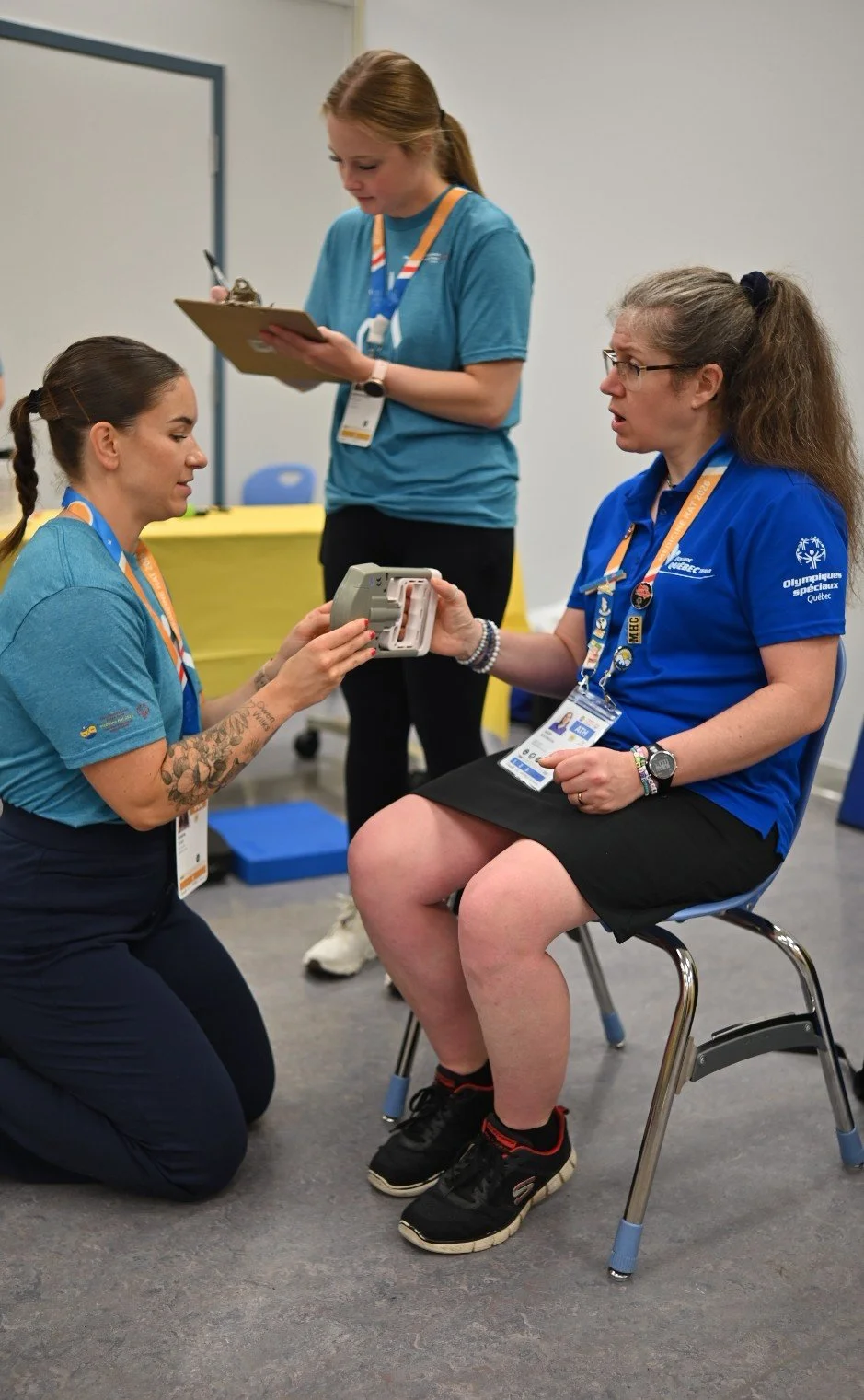
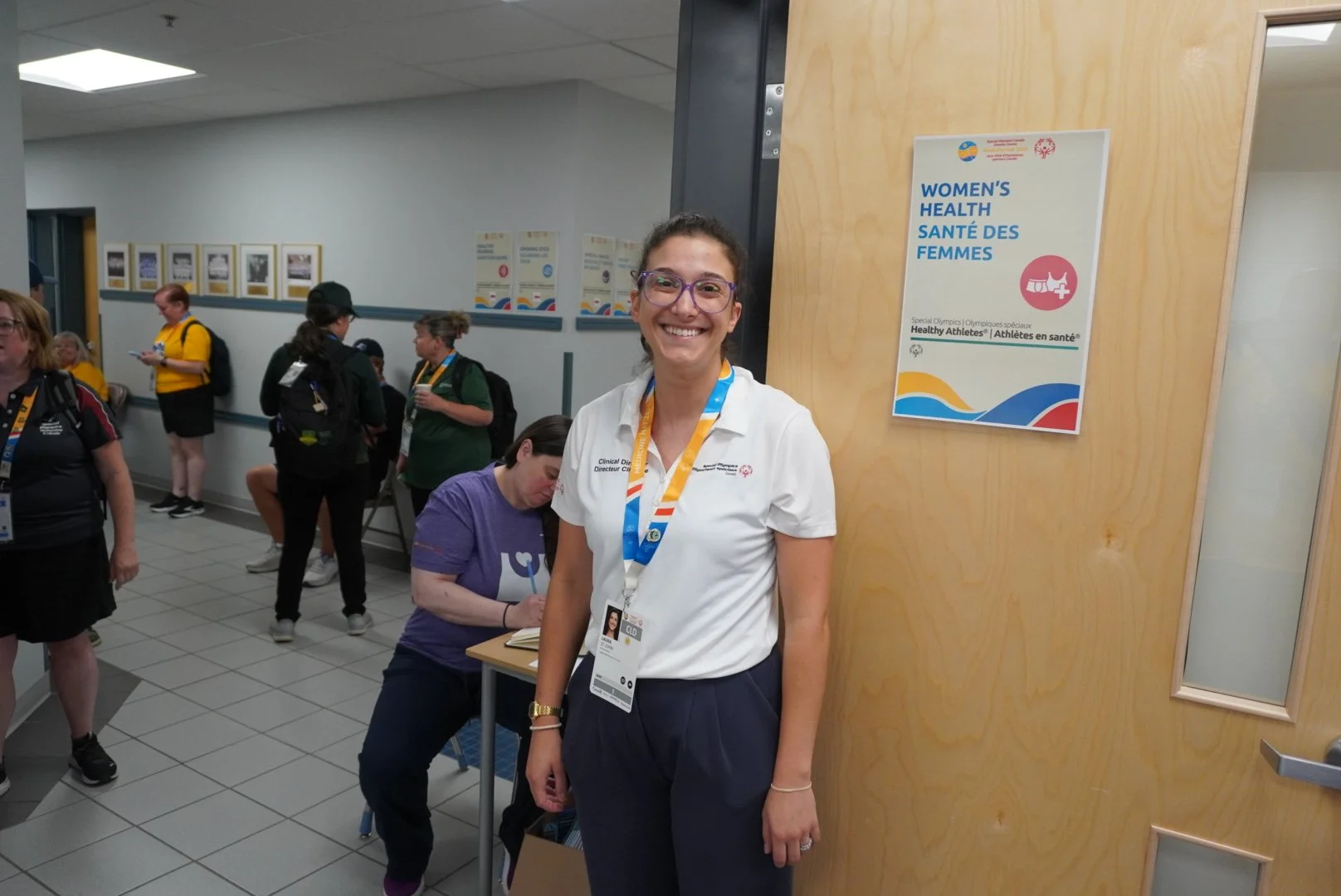
However, properly fitting bras are only one of the women’s health initiatives at these games. Another is training female athletes on things like self-examination for breast cancer, bone strength, and menstrual health. For that, say hello to the official doctors: Dr. Laura St. John, Dr. Patricia (Tish) Doyle-Baker, and Dr. Tara Lee-McHugh, all from the University of Calgary. They are leading the women’s health clinic within the Healthy Athletes program and are always eager to discuss their outreach and research. Extremely eager.
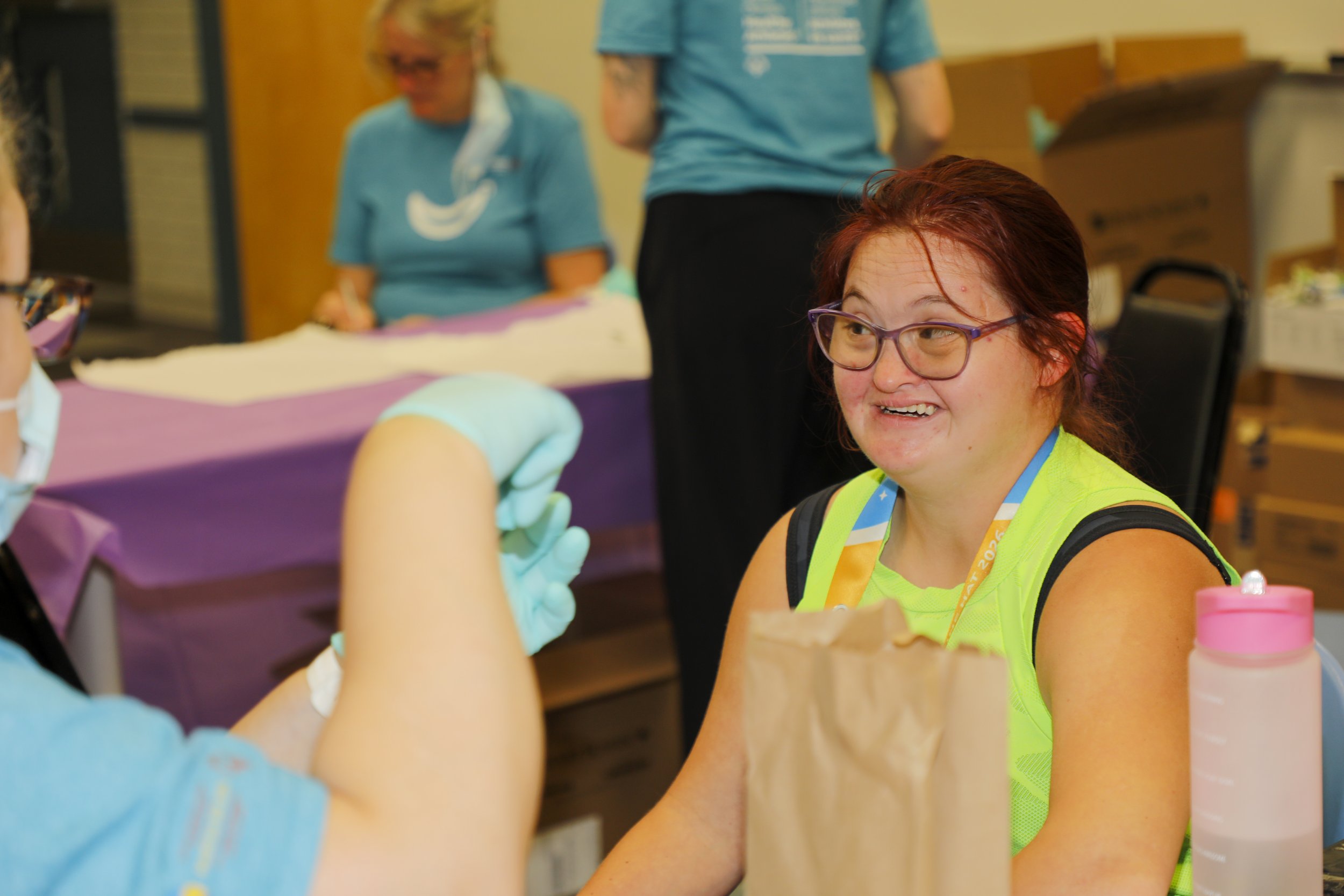
A substantial element of outreach and education is giving the athletes tactile examples, as explanations alone may not reach them. A popular activity involves detecting breast cancer through self-examination. Let’s play a game of find the lump.
Honestly, these models would be helpful for all women, not just these athletes.
As Dr. Doyle-Baker pointed out: “20 years ago, a woman at UBC did a study asking women if they would touch their breasts because we used a breast self exam as a major way to determine it. (Most) said they wouldn't touch their breasts… It's kind of a generational thing.”
Many young women today were raised with a similar reticence to touch their own breasts; part of the outreach is encouraging women with IDDs to check themselves regularly and let someone know when they have an irregularity. What the doctors can’t answer right now is whether the athletes are actually doing the self-exams. But as for the display at the women’s health clinic, Tish affirms: “They love it when they find the lump.”
A second project within women’s health is the osteoporosis display. Women are all too familiar with that word, especially as we age. Many athletes at Special Olympics are delighted to hear that they are already engaged in an activity that should lower their risk for the condition later. However, the disorder isn’t so simple.
Research in non-disabled female athletes indicates that several factors beyond merely exercise can affect bone strength and density. Nutrition, hormones, and mechanics all weave a complex pattern with sometimes unintended consequences. Rather than building bone density, female athletes may inadvertently decrease it through training and even through dietary choices meant to improve performance.
And then there are the injuries, which all athletes will likely experience at some time. Musculoskeletal trauma can cause complications that may increase the chances of later problems with bone health. Dr. Doyle-Baker explained that injuries lead to shifts in movement and posture that may cause uneven wear if not properly treated. Unfortunately, athletes with IDD are often hesitant to admit that they are experiencing pain because they fear it will mean they can no longer play.
One of the goals with education in bone health is to encourage athletes to say when they are experiencing pain, and to reassure them that getting treatment will actually help them to play longer. Getting athletes to ask for help is also important because, among other things, these athletes may age faster than those who do not have an IDD. Faster aging means differences in how their bone strength and density changes over time.
However, as Dr. Doyle-Baker stresses, little research has been conducted in this area. “We will in the very near future have the Olympians come through and scan their bones and we'll get an idea of where they are in terms of age and whether they are actually deteriorating more quickly. So instead of having osteoporosis… they might have osteopenia at an earlier age because they do age quicker. And if their lifespan is shorter, potentially their health span is compressed as well. So, this is work that needs to be done.”
Work that needs to be done. That’s a theme throughout the Healthy Athletes program, but especially in the Women’s Health Clinic, where two traditionally understudied groups collide: athletes with IDD and women. One area mentioned above that does get some attention is called the Female Athlete Triad, with the unfortunate acronym FAT, which could definitely use a rebrand. But that’s not within the scope of this article.
The triad comprises three health-related components that function in unison: low energy levels that may or may not be caused by an eating disorder; bone health; and reproductive function. The low energy levels related to nutrition are treated in the health promotion clinic of Healthy Athletes.
This brings us to the third part of the women’s clinic, the menstrual cycle.
All three of the doctors are passionate about teaching the athletes about reproductive health, but none more so than Dr. Laura St. John, who is the clinical director of the Women’s Health initiative. This is really her jam. And like the find the lump game, the clinic offers a fun hands-on activity, this time, a puzzle. Dr. St. John explains its function and purpose well.
“We have this one, the pelvis, which shows our different organs… your bladder, your uterus, your intestines, and your ovaries. And then we have the other, our uterus there with the fallopian tubes and all of the different anatomical pieces that make up our reproductive organs.”
And what is the purpose of having athletes assemble these puzzles?
“It's really just to get athletes an opportunity to become more familiar with those terms. Understanding the anatomy is really important for understanding your health, where pain is and knowing that pain maybe is in my ovary versus that pain is in my stomach. (And it can) introduce those terms in a more interactive way than just talking to the athletes about it. It gives an opportunity to develop some dialogue around it and to talk to them in a lower stress environment.”
Getting dialogue going about menstruation is tough. So many elements affect menstrual health, but as almost any woman will tell you, it’s not something we like to talk about. Most of us are reticent to discuss things like the ovaries, uterus, menstruation, and menopause, even when something appears to be wrong. Women with IDD are even less likely to talk about them. And don’t even go near the dreaded tampon aisle. All three doctors got in on this conversation, only part of which is shared here.
Dr. McHugh: “We need to be able to work with all of our women athletes to be able to discuss these topics and to say, how can we make sure that you're getting the opportunities to participate at all times of the month? Particularly for our swimmers, that's what we were hearing is just sitting out, maybe during, you know, their period, sitting out for the week.”
Dr. Doyle-Baker: “There's a lot of misunderstanding around the risk of getting the toxic shock… But I think also in teaching someone around their menstruation, it is a lot easier to show someone how to use a pad versus teaching how to use a tampon… There is also fine motor issues. So, you know, that process is a little bit more challenging if your fine motor is weaker than putting on a pad or, you know, using period underwear or something like that.”
Dr. McHugh: “Leak-proof bathing suits just aren't part of our equipment. Yeah, it's an option. It's just, I don't want to say an easy fix, but if that's a reason that's keeping athletes out of the pool… just seems like a natural, easy fix, if you will.”
Education and equipment support. Two key features that come up repeatedly.
Irregularity is also crucial for identifying potential problems early. Menstrual cycles for female athletes does get some attention in the research, particularly as it relates to the Female Athlete Triad. Menstrual cycles may be a way to identify when something is functioning improperly with an athlete, particularly in detecting low energy. Combinations of low energy and menstrual irregularities can lead to increased injuries, which will ultimately affect bone strength. It’s all part of a whole-body approach to women’s health, one that is especially relevant for female athletes with IDD’s.
As with many other health-related issues, having an IDD doesn’t just affect intellectual ability; it affects the whole system. Women with IDDs may have different menstrual flows associated with their disability; after all, as health care practitioners throughout Healthy Athletes will tell you, the brain is in charge of the entire system. If the brain is different, then that will likely affect the rest of the body as well. Dr. St. John has made some interesting findings in this regard.
“We've been doing a lot of research in this area and understanding menstrual health, and what we're finding is that people with intellectual disabilities tend to have heavier periods… Periods that are a little bit longer than what we would think is typical. And cramping can be a bigger issue… We are kind of seeing that there's potentially some reproductive conditions like endometriosis that maybe are going undiagnosed or PCOS that's going undiagnosed.”
As with almost everything in the Women’s Health initiative, however, research is scarce. Dr. St. John may be the only researcher who currently has this as her major area of investigation. She has conducted a couple of studies, but outside her own research, a lot of what she relies on is anecdotal.
“There's actually no other literature that exists around menstrual health (for women with IDD’s). A lot of what we get, especially in reproductive health, comes from caregivers… But it's really important that we're getting the information directly from the individuals with intellectual disabilities themselves.”
Ultimately, what is needed is more research. This includes studying the unique conditions that affect female athletes with IDD’s, but also research on educating the athletes. Education is a critical element of the Women’s Health initiative: passing on the knowledge that each of these beautiful and unique women needs to be a better athlete and healthier individual. It’s a process, and so far, this is a bold and promising move toward achieving better health outcomes, not only for the women at these games but for those across the country. As Her Excellency, the Right Honourable Governor General of Canada, Louise Arbor said after visiting the Women’s Health Clinic:
“I would say it is long overdue in so many walks of life. But in this context, you just have to talk to the people there at the clinic. It's just wonderful. And I hope it's going to take root and be available across the country.”
And judging by the smiles on the athletes faces as they leave the clinic, they think it’s wonderful, too. At the end of the women’s health session, each athlete walks out with a new bra and a smile, better equipped to get the support she needs – in more ways than one.
— story by Roz Hirch, Special Olympics Canada Summer Games